
Path Along the Wire. The First Step
15. 4.—8. 11. 2026

Path Along the Wire. The First Step
15. 4.—8. 11. 2026
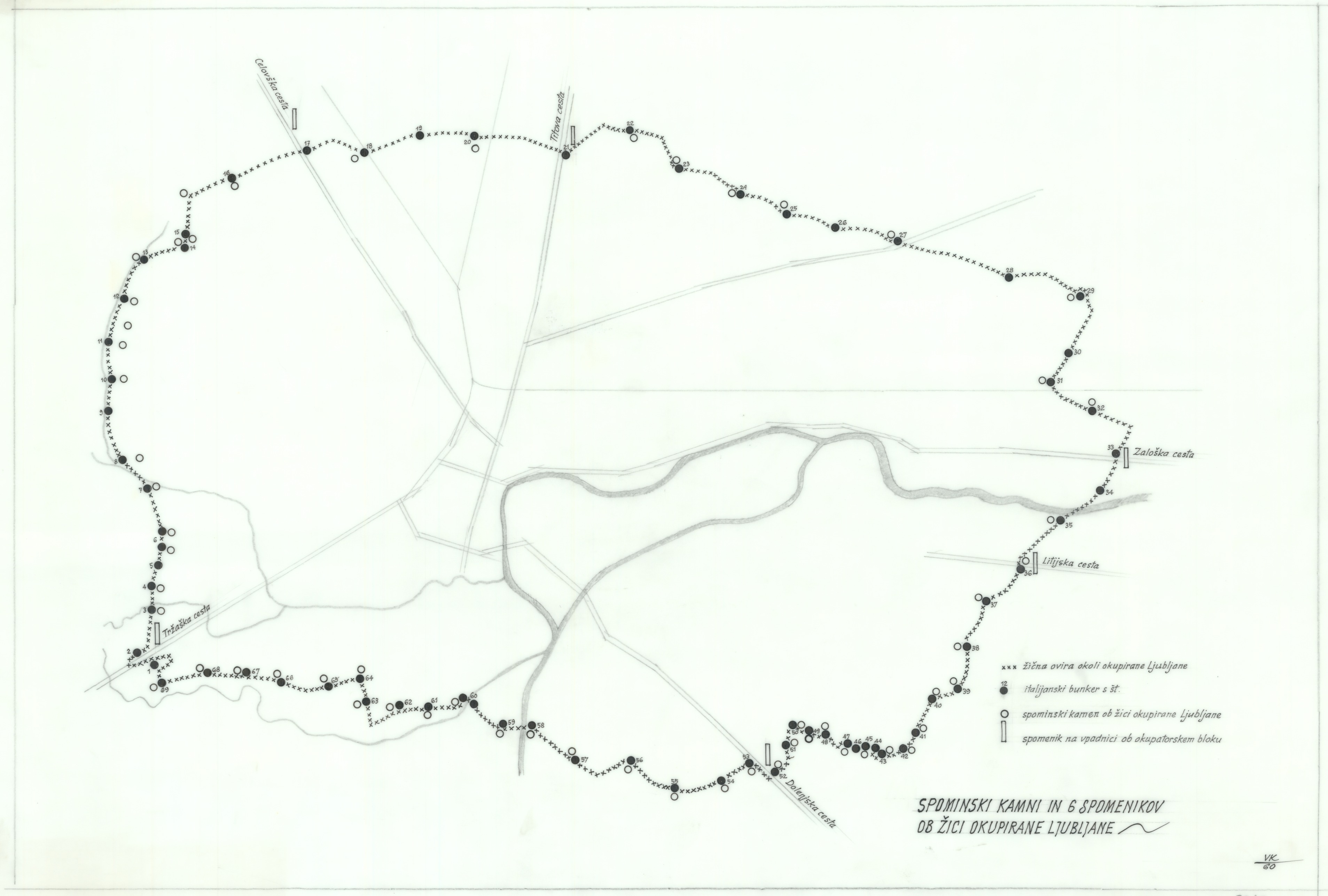
In 2026, when many Slovenian museums and institutions are dedicating their activities to exploring and presenting the work of architect Vlasto Kopač (1913–2006), MAO is exhibiting his project The Path Along the Wire. Over the decades and through social changes, the path has changed its name—originally the Path Along the Wire of Occupied Ljubljana, it later became the Path of Remembrance and Comradeship, then the Avenue of Remembrance and Comradeship, the Green Ring, and finally simply PATH. It is a monument to occupation and resistance. It is a monument, but not an object; rather, it is a space that enables a ritual of commemoration through walking. At the same time, it serves as a recreational area, a city park, and a sports infrastructure. The Path Along the Wire is an unfinished, constantly evolving project. It began as a cart track that followed the traces of wartime-occupied Ljubljana, along the route of the barbed-wire perimeter that, for 1,117 days, separated the city from its hinterland within a circle spanning tens of kilometres. Over the decades, the path has gained new dimensions, meanings, and arrangements. In the 1970s, it was transformed into an avenue—a 4-metre-wide gravel footpath lined with trees (based on a proposal by Mitja Omersa, Franc Kastelic and Jože Štoka). In the 1980s, it gained a new visual identity and highlighted entrances (according to plans by Janez Koželj et al.), and in recent decades, it has been enhanced with signage, bridges, and other equipment.
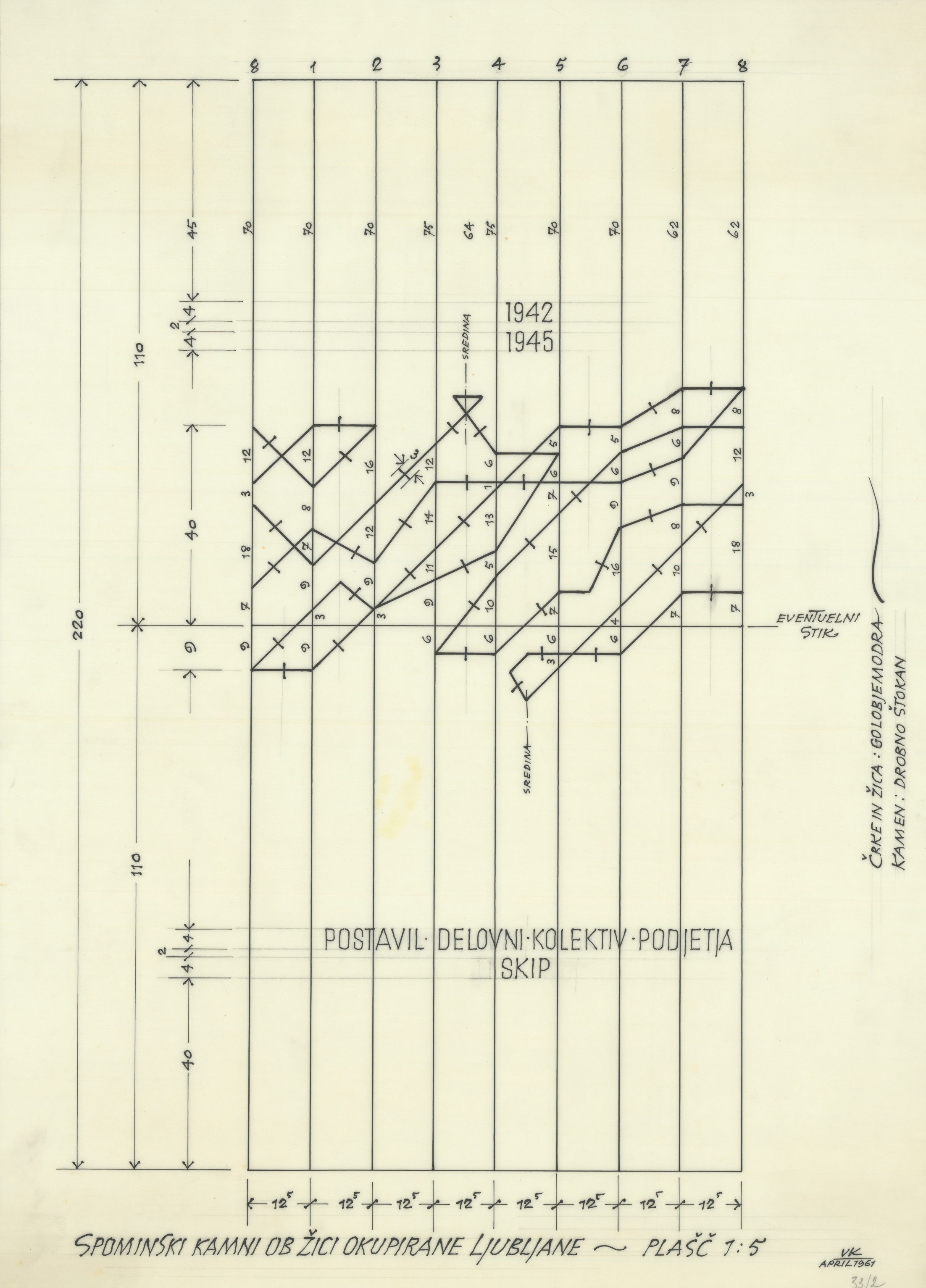
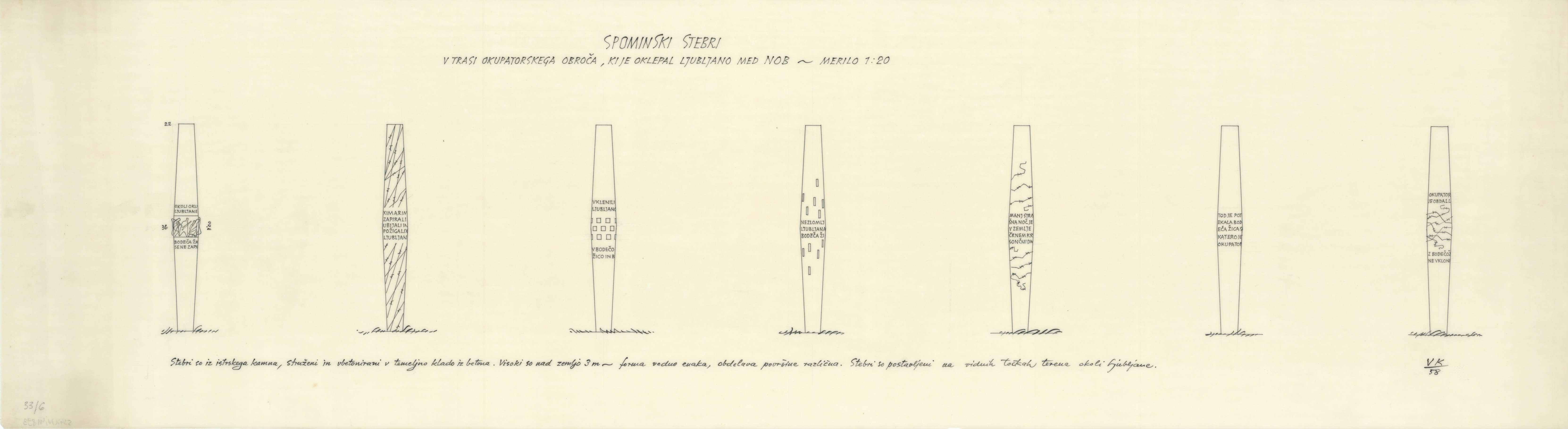
The exhibition focuses on the first stage of the path: Kopač’s project to stake out and mark the route. It highlights this as a key step, as a starting point, in shaping a project that continues to develop to this day. After the first partisan march in 1957, which revealed that the path was untidy and difficult to follow, Kopač defined and staked out the route. How to turn a cart track into a walking path, and the remains of occupation into a memorial? According to Kopač’s plans, 102 pillars—octagonal stones engraved with a barbed wire—were installed near the bunkers. Monuments featuring sculptural reliefs were installed at the crossing points, serving as landmarks. Much like a mountain trail, the route has thus gained a recognisable, visible, and easily traceable direction through its well-trodden path and the placement of signs.
The exhibition, presented as part of the Preview exhibition series, showcases materials preserved in MAO’s collection, complemented by Dejan Habicht’s photography project, which, through systematic documentation of the monuments, interprets our history. Kopač’s memorial stones are thus no longer merely markers in space, but also become the scenography of our recent history, revealing what the transition has brought and how the spatial context has changed.
Curator: Martina Malešič
Participating artist: Dejan Habicht
Exhibition design: Jan Kozinc
Graphic design: Grupa Ee
Translations and proofreading: Nika Skok Petranovič, Katja Paladin
Project coordinator: Blažka Kirm
Technical realisation: Jan Kozinc, Tadej Golob, Matjaž Rozina, Matija Cvetičanin, Ana Lilija, Nils Rosker, Patricija Šošter
Accompanying program: Natalija Lapajne
Expert support: Nika Novak
For the exhibition setup, we used, albeit in a modified folm, the display construction that had been specially designed for the MAO chapel exhibition space (authors Maša Ogrin and Boštjan Vuga, 2017).
Special thanks: Janja Železnikar, Katja Šturm, Petra Iskra (TV-arhiv in dokumentacija, RTV Slovenija), Anja Zver (Muzej novejše in sodobne zgodovine Slovenije), Urša Suhadolc in Darja Pergovnik (ZVKDS, OE Ljubljana), Manca Košir, Gregor Mljač
The exhibition is part of a series of events within the project Vlasto Kopač – a creator of space, guardian of heritage and memory. The lead partners of the project are the Intermunicipal Museum Kamnik and Plečnik House (Museum and Galleries of Ljubljana), and its partners are the Upper Sava Museum Jesenice – Slovenian Alpine Museum, the Institute for the Protection of Cultural Heritage of Slovenia, the Museum of Architecture and Design (MAO), the National Museum of Contemporary History of Slovenia, and the Anton Melik Geographical Institute of the ZRC SAZU.
MAO programme is funded by: Ministry of Culture of the Republic of Slovenia
