
More about Saša J. Maechtig’s Work
24. 11. 2015

More about Saša J. Maechtig’s Work
24. 11. 2015
Café Evropa summer pavilion, Useful waste container EKOS, Telephone hood and the iconic Kiosk K67 are some of Saša J. Mächtig’s design objects that characterised the daily life of Slovenian and foreign cities. Find out about some of the exhibited works!
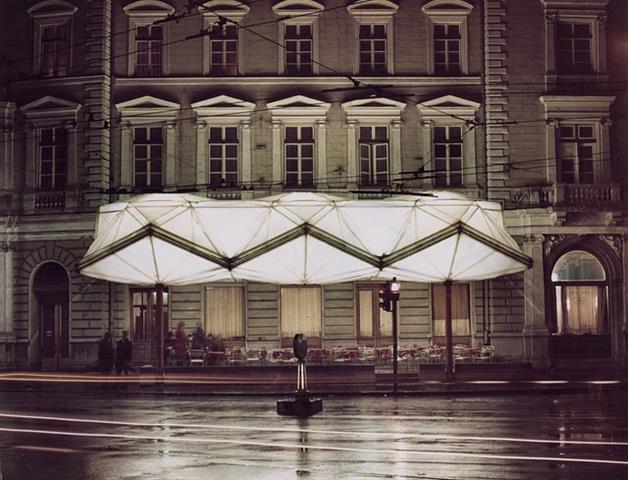
Café Evropa summer pavilion, Ljubljana
1966–1969
Produced by: SKIP and Imgrad
The summer pavilion of café Evropa was Mächtig’s first independent project. The innovative construction of the overhang was based on a study of geometric truss models and his study of rhythm, proportions, structures and modularity of basic individual elements. The central element of the summer pavilion was a plastically designed roof mounted on a voluminous truss construction. It was covered with a transparent, reinforced polyester membrane in parchment colour that came in two monolithic pieces. The light sources in the interior made the roof glow at night. With his design, Mächtig aspired to create a visually compelling spot that would serve as the centre of attention in the otherwise unorganised area of the intersection. The composition principle of the basic construction unit – the trilateral pyramid – was also envisaged for the serial production of roof elements with pylons of different sizes and a minimum number of support pillars.
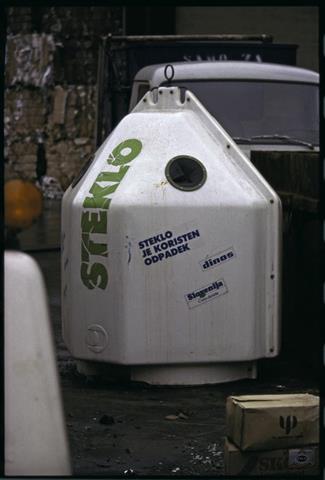
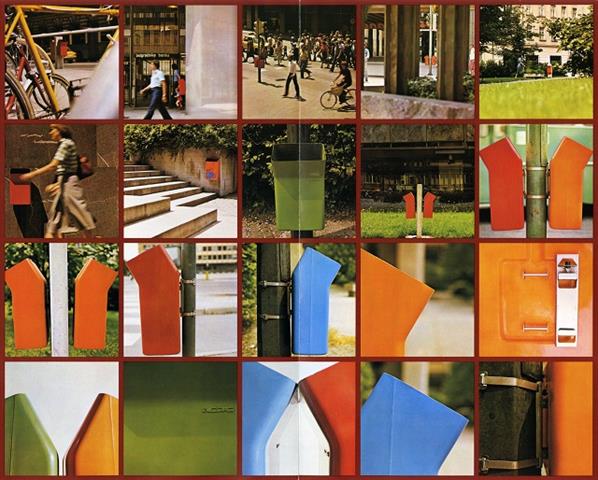
Useful waste containers (EKOS)
1983-1986
Produced by: Donit, Plastor
The useful waste containers project was one of the first in Slovenia that systematically tackled the collection of waste at the level of the city and public space. The design of the container followed the idea of modularity and integration of individual units into groups. The shape therefore starts with a square-shaped layout with rounded corners at the base and finishes with a pyramid-shaped top. The body of the container, which was composed of two identical halves, rested on a round plinth that had an integrated bottom with a dumping mechanism. Two basic types of different sizes and an extended container with an interface were developed. Following the first test campaign that took place in Ljubljana in 1986 the containers were then installed in other cities as well.
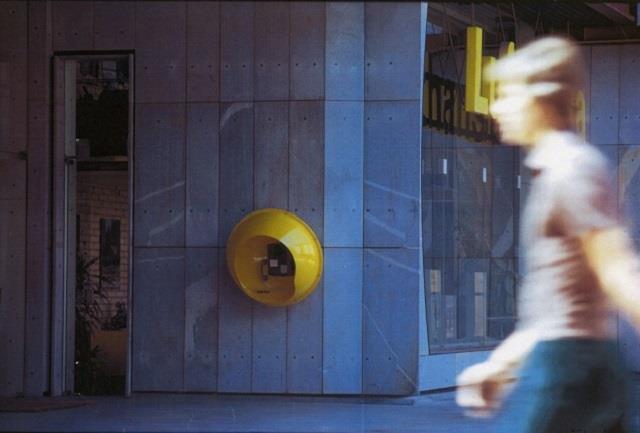
Telephone hood
1971–1972
Produced by: Pečenko
The telephone hood isolates and suppresses the surrounding noise, so it was frequently used as a replacement for an enclosed, self-standing telephone booth. It consisted of two shells made of plexiglass that were bolted together on the outer edge. There were two shell types: the TD 1 hood was designed for the internal or local telephone and TD 2 for the long distance phone. The basic version of the hood was mounted on the wall, whereas stand-alone installations in clusters and batteries with up to eight hoods were planned for locations with a higher frequency of traffic. Later on, two projects were designed for a system of covered hoods as stand-alone objects.
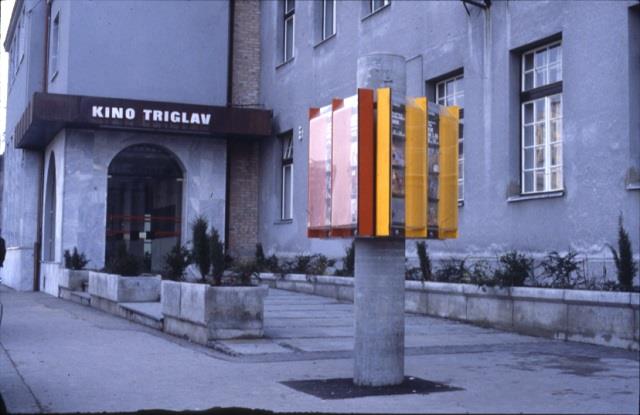
Cinema programme info display cabinet
1973–1974
Produced by: Pečenko and Termika
The cabinet design was based on a study of human perception of information in motion, which determined the size of the cabinets and font structuring. The basic element is a plastic (reinforced polyester) shell with side edges protruding outwards and covered with a transparent plexiglass shield with a lock. The permanent information – the name of the cinema – is written with the characteristic font on the side edges. The cinema cabinets were wall-mounted or hung in a triangular layout on an asbestos cement column.
Mächtig developed several variations of the cabinet, such as large double cabinet, a cabinet for the Slovenian Philharmonic, and a cabinet for Ljubljanska banka.
Frog waste bin
1968–1976
Produced by: Elan and Imgrad
Frog waste bins belong to the family of the Kiosk K67 system, as they were originally designed for kiosk users. Saša J.Mächtig designed five versions of reinforced polyester bins, but two basic types Frog 1 and Frog 2 saw the light of day.
Frog 1 is a stand-alone bin with two slot openings. Frog 2 was the smaller version and used a stainless steel mechanism for mounting on walls or stand-alone objects such as street lamp-posts. A stand-alone concrete pylon project was also developed.
Both waste bins were tested several times in the public environment. Test waste bins with an attractive graphic design were installed in the framework of the White Ljubljana campaign in 1975.
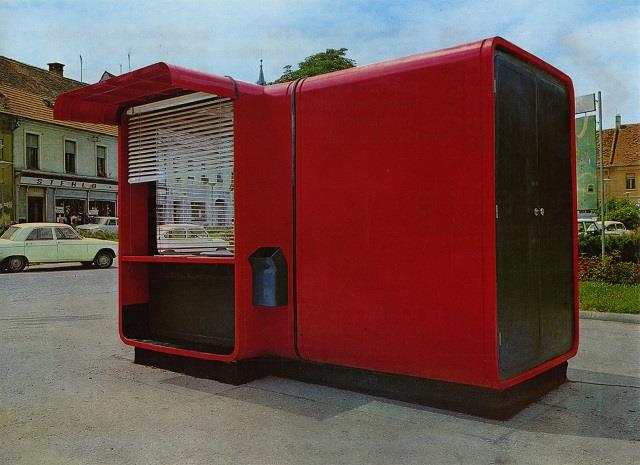
Kiosk K67: Ist generation
1967 project
1970 serial production
Produced by: Imgrad
The modular Kiosk K67 system was conceived as a response to calls for technically and aesthetically well-designed facilities that would promote the development of street vending and other services offered in the street. The system was based on five modular spatial elements made of reinforced polyester (the cross-shaped units, corridor link pieces and triangular units were produced serially) that could be freely assembled into various spatial configurations. The basic elements were complemented with a series of different fillers, overhangs and interior design. Soon after it was first shown to the public in Ljutomer in 1969 the English journal Design published an article on the K67 that received a lot of attention. The kiosk was included in the MoMA (Museum of Modern Art) design collection in New York in 1970. The second generation of kiosks soon followed and introduced technological improvements and an optimised production process, as well as the construction of the load-bearing shell that could be decomposed, unlike the original monolithic structure.
Info
Click on the image to view the gallery!