
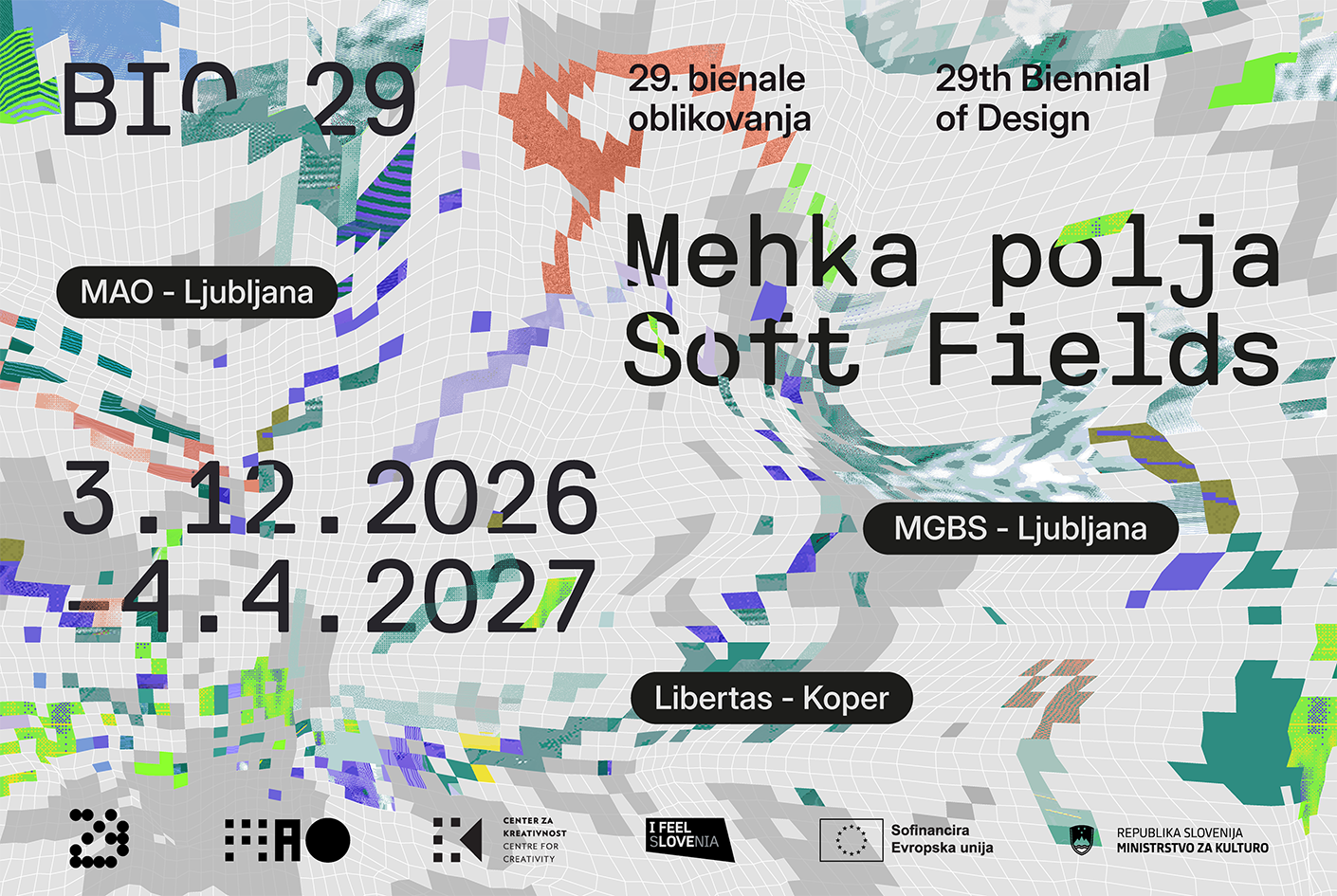
BIO 29: Soft Fields
3. 12. 2026—4. 4. 2027

BIO 29: Soft Fields
3. 12. 2026—4. 4. 2027
BIO 29, titled Soft Fields, explores how design practice can open up, redirect and redistribute knowledge embedded in research, industrial and infrastructural environments.
The exhibition approaches industry not as a series of production sites or products, but as an integrated system of power, capital and nature, shaped by a specific division of labour, modes of reproduction and the logic of accumulation. People, technologies and territories enter its production chains from unequal positions, and these very asymmetries are fundamental to the way industrial systems operate.
The capacity of design to bring about change is inseparable from these conditions. Its possibilities depend on the context in which it operates, and on whether it aligns with or challenges the social, geographical and informational hierarchies it seeks to address. The exhibition explores a shift towards relational, multi-scalar design practices informed by flows of energy, resources and labour, and by their interconnectedness within ecosystems.
BIO 29 continues a tradition of collaboration that the Biennale of Design has been building since 1964. The exhibition programme brings together three interconnected strands. Experimental Practices presents new design projects developed in Slovenia in collaboration with local research institutes, companies, cultural institutions and other knowledge holders. Works of Resonance brings together projects from other geographical contexts that pursue related lines of inquiry while redefining what design can encompass. Both strands are connected by Afterclass, a curatorial research project that traces the archives, infrastructures and forms of knowledge on which they are based.
The exhibited works are organised around eight industrial operations: observing, organising, transforming, including, distributing, maintaining, adapting and representing. Read as verbs rather than categories, they describe what industry does and where design can intervene in its operations, redirect them or refuse them.
BIO 29 across three venues
From 3 December 2026 to 4 April 2027, BIO 29 will take place across three venues: the Museum of Architecture and Design (MAO) and the Bank of Slovenia Gallery (Mala galerija Banke Slovenije) in Ljubljana, and the Libertas Cultural Centre in Koper. The exhibitions at these different locations approach the Biennale’s shared framework from distinct perspectives.
The exhibitions will be open during the following periods:
- Museum of Architecture and Design (MAO), Ljubljana >>
3 December 2026–4 April 2027 - Bank of Slovenia Gallery (Mala galerija Banke Slovenije), Ljubljana >>
2 December 2026–4 April 2027 - Libertas Cultural Centre, Koper >>
4 December 2026–4 April 2027
DON’T MISS IT!
BIO 29 will be accompanied by a three-day opening programme in Ljubljana and Koper. From 2 to 4 December, join us for exhibition openings, talks, guided tours, workshops and encounters with the people involved in this year’s Biennale, offering different perspectives on its themes and projects.
The full programme and further information about individual events will be available at bio.si.
About the Biennale of Design
Founded in 1964, BIO – the Biennale of Design – is one of the oldest design events in Europe. It is organised by the Museum of Architecture and Design (MAO) in cooperation with the Centre for Creativity (CzK).
Curator: Martina Muzi
Associate Research Curator: Ro Pérez Gayo
BIO 29 is organised by the Museum of Architecture and Design (MAO) in cooperation with the Centre for Creativity (CzK). The project is co-financed by the European Union and the Republic of Slovenia.
The BIO team would like to thank all participants, collaborators, lenders and supporters for their contribution to the Biennale.
CREDITS
BIO 29: Soft Fields
Curator: Martina Muzi
Associate Research Curator: Ro Pérez Gayo
Head of BIO: Maša Ogrin
Graphic Design: Studio Multipraktik
Exhibition Design: Luka Murovec
Production Platform Coordinator: Amadej Mravlak
Production and Logistics Coordination: Matjaž Brulc
BIO Communications: Manca Košir
Production Assistant: Urška Kleindienst
Photography: Klemen Ilovar
Curatorial Production Assistant: Brogen Berwick
Assistant Exhibition Designer: Matteo Guzzo
BIO Intern: Karla Rosić
Technical Editor: Ajda Bračič
English Translation: Darja Horvatič
Italian Translation: Laura Castegnaro
Proofreading: Jeff Bickert, Vida Jocif
MAO and Centre for Creativity Team
Maja Vardjan, Director of MAO; Anja Zorko, Head of the Centre for Creativity; Uroš Pangerc, Assistant Director of MAO; Kristina Dešman, Blažka Kirm, Dr Martina Malešič, Cvetka Požar and Špela Šubic, MAO Curators; Natalija Lapajne and Maja Šuštaršič, Education Department; Danaja Batinič, Ela Mejač and Eva Simonič, Centre for Creativity; Ana Kandare, Head of Marketing; Gregor Mljač, Public Relations; Tanja Vergles, Office Secretary; Matjaž Rozina and Tadej Golob, Technical Realisation.
Contributors
The development of projects and the realisation of BIO 29 involve numerous designers, researchers, experts, institutions, companies and other organisations. These include:
430th Naval Division of the Slovenian Armed Forces, Biotechnical Faculty of the University of Ljubljana, Faculty of Architecture of the University of Ljubljana, Anton Melik Geographical Institute ZRC SAZU, Slovenian Forestry Institute, InnoRenew CoE, Jožef Stefan Institute, Institute for Philosophical and Religious Studies, Institute of Cultural and Memory Studies ZRC SAZU, Institute of Contemporary History, Karst Research Institute ZRC SAZU, Marjetica Koper, Koper Central Wastewater Treatment Plant, Mediterranean Institute for Environmental Studies, Slovenian Mycological Museum, Municipality of Trbovlje, PiNA Koper, Legal Centre for the Protection of Human Rights and the Environment, RTV Slovenia, Sinergise Solutions, Soline – Salt Production, Slovenian Maritime Administration, Zasavje Museum Trbovlje, Slovenian National Building and Civil Engineering Institute, Slovenia Forest Service and Science and Research Centre Koper.
Supporters
Pro Helvetia – Swiss Arts Council, Italian Institute of Culture, Embassy of Sweden in Budapest, Embassy of the Kingdom of Spain, Embassy of the Republic of Austria, Austrian Cultural Forum, Embassy of Switzerland, Embassy of the Republic of Poland, Adam Mickiewicz Institute, Embassy of the Italian Republic, Embassy of France, French Institute in Slovenia, Embassy of the Federal Republic of Germany and Goethe-Institut.
Benko-Tehna, Inox center, Bossplast, Cebort, Legit and Intermedia.